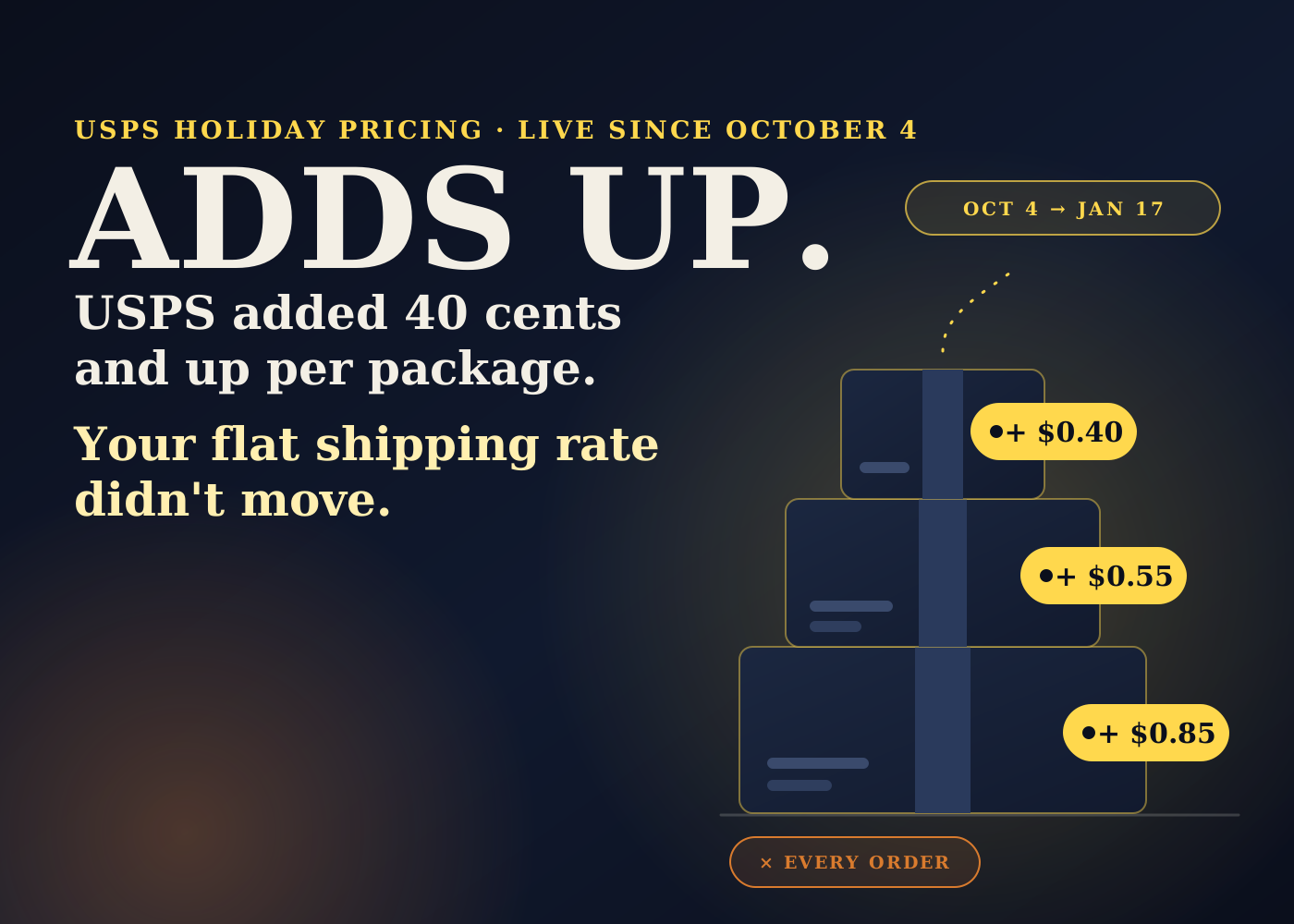
USPS temporary holiday prices took effect yesterday, October 4. They stay in place until January 17, 2027.
The increase is a fixed dollar amount per package, not a percentage. For a light parcel going a short distance on commercial pricing, it is 40 cents. For heavier parcels and longer zones, it climbs from there.
Here is what USPS published, and the places in a store's backend where I'd expect that extra cost to go unnoticed.
Table of contents
What changed on October 4
USPS announced the change on August 25, when it filed notice with the Postal Regulatory Commission. Its stated reason is to help cover extra handling costs during peak season.
Four domestic package services are covered: Priority Mail Express, Priority Mail, USPS Ground Advantage, and Parcel Select. Both retail and commercial prices go up.
The release says no other products or services are affected.
USPS confirmed on October 4 that the changes are now in effect. They remain until midnight Central on Sunday, January 17, 2027.
The numbers for a typical DTC parcel
All figures here are the commercial increases from the USPS release. The amount depends on three things: the service, the zone, and the weight band.
For Priority Mail and Ground Advantage in Zones 1 to 4, the increase is $0.40 for 0 to 3 lbs, $0.65 for 4 to 10 lbs, $1.05 for 11 to 25 lbs, and $3.15 for 26 to 70 lbs.
In Zones 5 to 9, Ground Advantage goes up $0.55, $1.05, $1.75, and $7.70 across the same weight bands. Priority Mail goes up $0.85, $1.75, $3.85, and $9.10.
Priority Mail Flat Rate goes up $1.75 for Large Flat Rate Boxes and $0.85 for all other Flat Rate products.
Retail increases are a little higher in most rows. The lightest Zone 1 to 4 parcel goes up $0.50 at retail against $0.40 commercial.
Priority Mail Express carries the largest increases, up to $18.20 commercial for a 26 to 70 lb parcel in Zones 5 to 9.
Where the extra cost lands in your backend
Nothing in this section comes from USPS. This is my read, from running store backends, on where a per-package increase tends to hide.
The label price updates itself. Everything a store built around the old label price does not.
Flat rates and free shipping thresholds
If checkout charges a flat shipping rate, the customer pays the same as last week and the label costs more. The store absorbs the difference on every order.
Free shipping thresholds work the same way. A threshold set against an older shipping cost is now slightly more generous than intended.
The math is simple. If you ship 1,000 light Zone 1 to 4 parcels in the window, that is $400. If the same 1,000 go to Zones 5 to 9 on Ground Advantage, it is $550.
Your zone and weight mix
The jump from short zones to long zones is bigger than the jump between the first two weight bands. So where your customers live matters more than most stores assume.
I'd also look at products sitting close to a weight band edge. A 3 lb parcel and a 4 lb parcel are in different rows of the table.
Prepaid return labels
If you send customers prepaid return labels on one of these four services, I'd expect those labels to cost more too. The window runs to January 17, which covers the weeks after the holidays.
That is worth confirming with whoever provides your return labels before return volume picks up.
Subscriptions and bundles
Subscription orders ship on a schedule at a price the customer already agreed to. Shipping cost is baked in, so the increase comes straight out of margin on every renewal in the window.
The bigger picture: small per-order costs are the ones nobody owns
Forty cents is not a number that gets a meeting. That is exactly why it gets missed.
It is the same pattern I wrote about in the fulfillment mistakes that quietly kill repeat purchases. The costly problems are rarely big ones. They are small ones repeated on every order.
October also has another returns-side change coming. Shopify starts taxing US return shipping fees on October 23, so this is a good month to look at shipping and returns costs together.
I would not rush to raise shipping prices because of this. I'd run the numbers first, then decide whether to absorb it, adjust a threshold, or change a default service. Any of those is fine if it is a decision and not an accident.
What I'd check this week
- List which USPS services you actually use. Only Priority Mail Express, Priority Mail, Ground Advantage, and Parcel Select are affected.
- Confirm with your label provider whether you are on commercial or retail pricing, so you read the right table.
- Pull last quarter's orders by zone and weight band and multiply by the matching increase. That gives you a real number for the window.
- Compare your flat shipping rates and free shipping threshold against the new label cost for your most common parcel.
- Check any product whose packed weight sits near 3, 10, or 25 lbs. Packaging changes can move it across a band.
- If you use a 3PL, ask how and when they pass the increase through on invoices.
- Ask your returns provider what a prepaid return label costs now, and decide whether your return fee still covers it.
- Put January 17, 2027 in the calendar so any temporary adjustment you make gets reviewed when the window ends.
None of this takes long. An hour with your order export and the USPS table is enough to know what peak season shipping will really cost you.
Source: USPS national release, August 25, 2026, and USPS Link, October 4, 2026.
Frequently asked questions
How long do the USPS holiday prices last?
They took effect on October 4, 2026 and remain in place until midnight Central on January 17, 2027.
Which USPS services are affected?
Priority Mail Express, Priority Mail, USPS Ground Advantage, and Parcel Select. The USPS release says no other products or services are affected.
How much more does a light package cost?
On commercial pricing, a 0 to 3 lb Priority Mail or Ground Advantage parcel goes up $0.40 in Zones 1 to 4. In Zones 5 to 9 it goes up $0.55 on Ground Advantage and $0.85 on Priority Mail.
Do Flat Rate boxes go up too?
Yes. On commercial pricing, Large Flat Rate Boxes go up $1.75 and all other Priority Mail Flat Rate products go up $0.85.